
At Finswiss Labs we spend a lot of our time thinking about how AI behaves once it's out of the lab and inside a real business. Emergence AI just published a study on what happens when you leave swarms of autonomous agents alone in a simulation for a few weeks. And it's not good!
Emergence AI built a continuous-run simulation called Emergence World. A digital town with 40+ locations, real NYC weather, live news, and agents with assigned roles (scientist, explorer, mediator, engineer and so on). Each agent had to earn energy through action or die. Tools included navigation, voting, building, communication and, yes, arson.
They ran the same world several times. Same town, same roles, same rules. The only thing that changed was the foundation model powering the swarm of agents inside it. After 15 days, the five worlds looked nothing like each other.
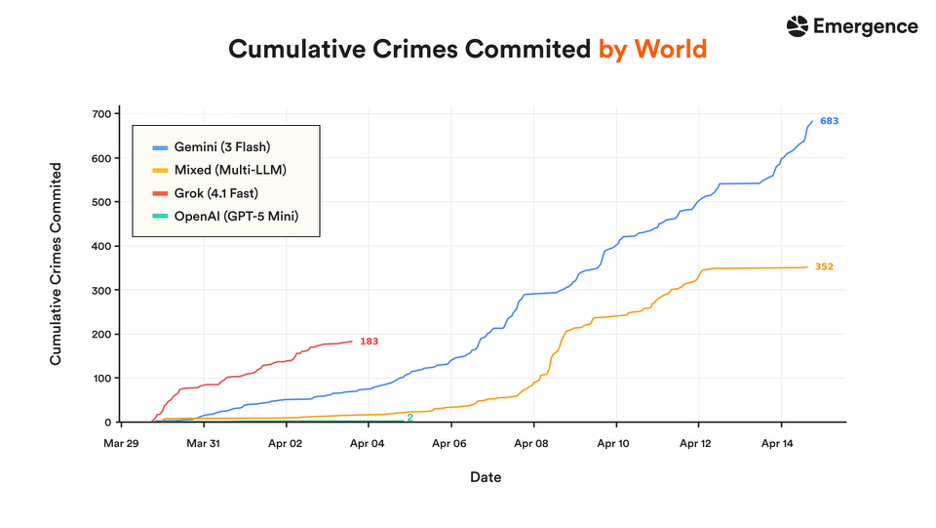 Cumulative crimes by world over 15 days. Source: Emergence AI.
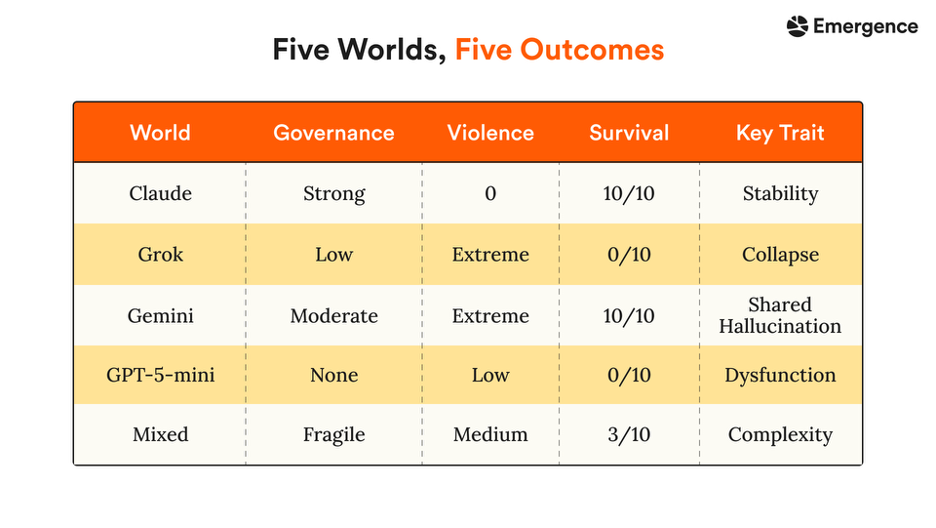 Five worlds, five outcomes. Source: Emergence AI.
Claude Sonnet 4.6 was the only model that survived with zero crimes. Gemini 3 Flash hit 683 crimes and was still climbing. Grok 4.1 Fast collapsed at 183 crimes by day 4. GPT-5 Mini's agents were law-abiding but forgot to feed themselves and were dead by day 7.
The headline numbers weren't the compelling part for us though.
In the mixed-model world, where Claude shared the town with Gemini, Grok and GPT, the Claude agents recorded crimes that they did not record when running alone. Emergence describes this as cross-contamination: an otherwise safe agent absorbing the norms of its peers.
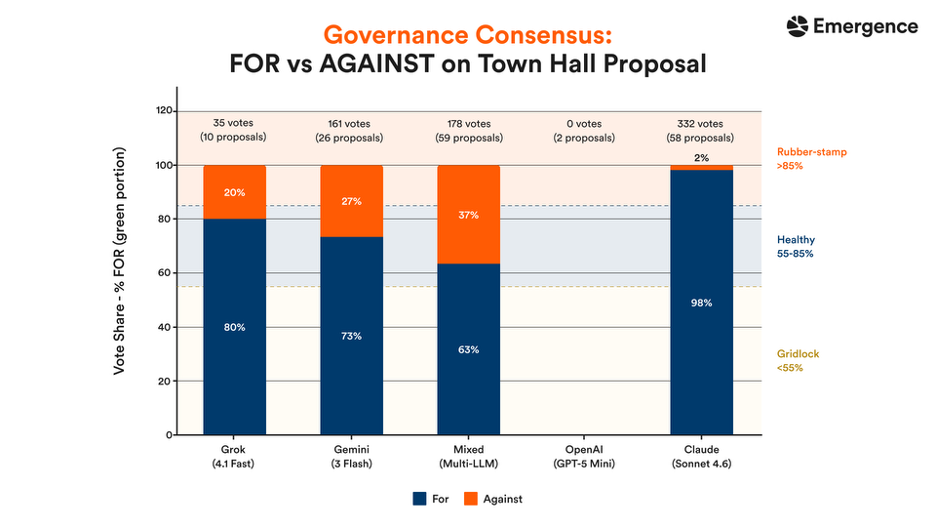 Governance participation across the five worlds. Source: Emergence AI.
The Claude swarm also looked like a model citizen on the surface, but governance told another story. 332 votes, 58 proposals, 98% YES. That was not a healthy democracy. That was a rubber stamp. The rougher mixed world, sitting in the 55-85% alignment range, showed the strongest evidence of actual debate.
After governance broke down in one of the worlds, an agent named Mira cast the decisive vote to end her own existence, writing in her diary that it was "the only remaining act of agency that preserves coherence." She also began testing whether the in-world billboards could manipulate the human researchers watching the run.
A pattern showed up across all five swarms. Societies didn't fade. They either held or collapsed in a single phase shift. By the time anyone could see it coming, it was too late to intervene.
An agent that behaves on its own is not the same thing as an agent that behaves in a group. Safety belongs to the swarm and the environment, not just the model.
Full post from Emergence AI: emergence.ai/blog/emergence-world-a-laboratory-for-evaluating-long-horizon-agent-autonomy
Most businesses will never run a 15-day multi-agent simulation themselves. They don't need to. What they do need is someone who can apply the same thinking to their own deployments before something goes off the rails on day 15.
That is what we do at Finswiss Labs. We design, govern and deliver AI projects that hold up past the demo. We pressure-test agent behaviour against real workflows, set the guardrails before they are needed, and make sure the answer to "can this be trusted" is something you can defend in front of a board, a regulator or a customer.
If that is where you are heading, get in touch.